



© Gabriel Monroy / Presidencia
By Sophia Appl Scorza and Baptiste Albertone
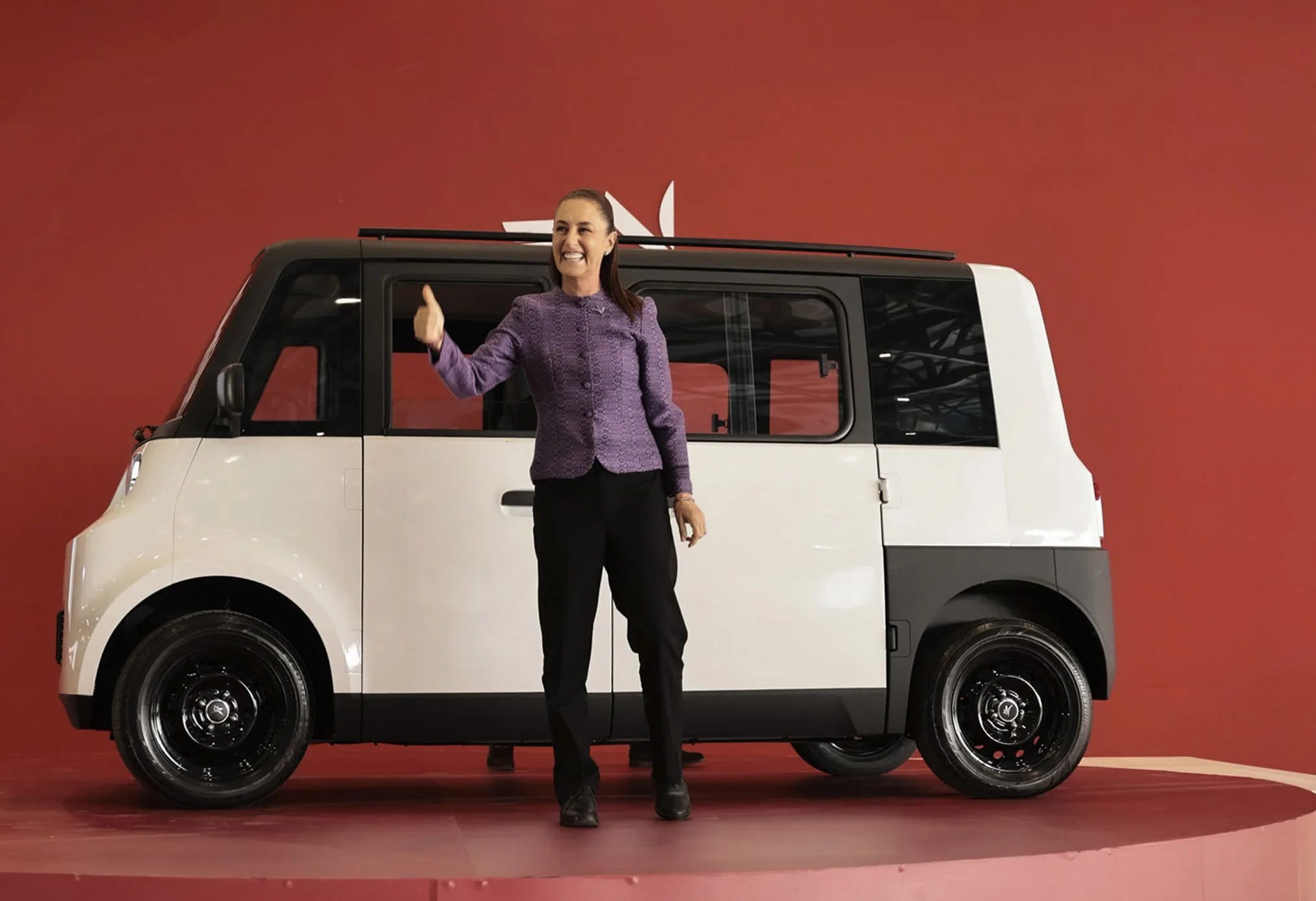
On 7 June 2026, the President of Mexico, Claudia Sheinbaum, announced the official launch of Olinia 1 (the Nahuatl word for ‘mobility’), the government’s strategic project for a domestic electric vehicle. Olinia is a micro-vehicle whose design resembles a miniaturised boxy minivan. It has been specifically imagined for urban centres, with a maximum speed of 50 km/h, seating up to six passengers, and a range of over 100 km on a single charge.
The Car of Discord
Since its public presentation, Olinia has been the object of intense debate. Many mocked its look, comparing it to a Little Tikes toy car on the internet. Others criticised its lack of safety (the car does not have an Anti-lock Braking System (ABS) or airbags), its high foreign content (around 50% in the first prototype) and its price (expected to sell at around 150,000 pesos, a bit more than US$8,600).
Many, however, identified with the declaration of President Sheinbaum at Olinia’s inauguration that: ‘[f]or a long time, people talked about how Mexico was a place only destined to produce what other people imagined,’ and that ‘Olinia is the proof that Mexico can go far beyond that’. What better provocation for a country that has been trapped for so many decades in the subordinate role of a car-assembler for foreign brands, than to release an electric Mexican car: a bet on the future as a provocation to the past.
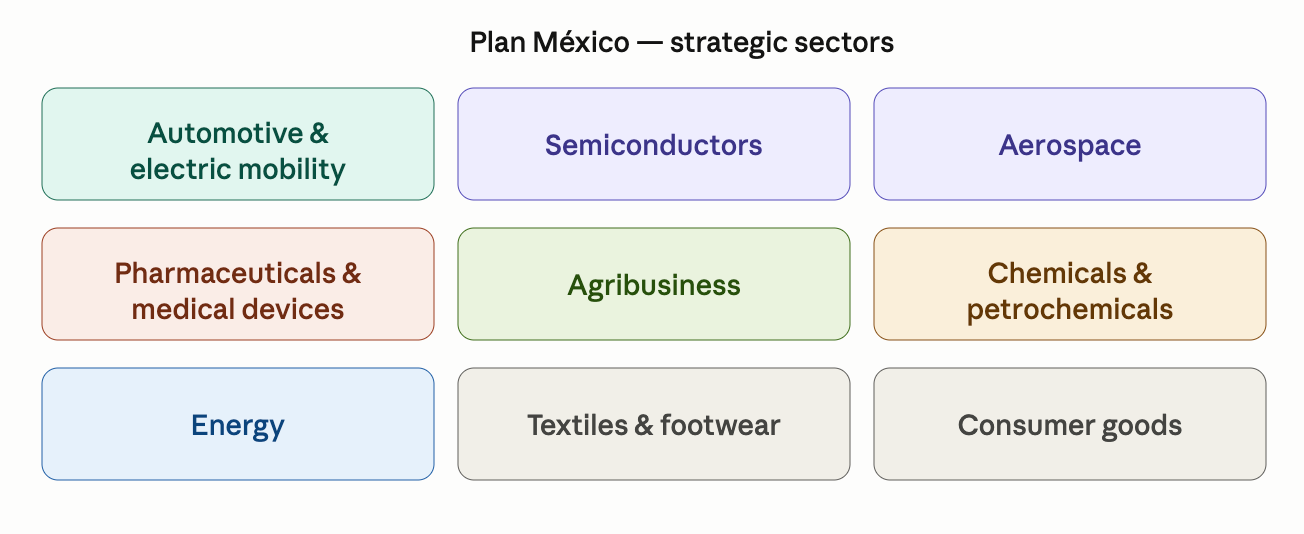
Olinia is not an isolated project. Since coming to power on 1 October 2024, Claudia Sheinbaum has announced a series of other strategic bets, e.g., Kutsari, a national semiconductor design centre; Quetzal, a Mexican-built military drone; or Taruk, a fully electric passenger bus (see below). All are coordinated by Mexico’s newly created science and innovation ministry (SECIHTI), and most sit within the wider framework of Plan México, the country’s industrial policy, which targets strategic sectors to transform Mexico’s economy (see below). Olinia and Taruk, in particular, aim to make Mexico an electric mobility player (the country is today the seventh-largest car manufacturer in the world, yet the only one in that ranking without a domestic vehicle brand).
These efforts mark a double historical rupture. First, with four decades in which neoliberal-leaning governments (1982–2018) actively dismantled industrial policy. Second, with the presidency of López Obrador (2018–2024), where the state recovered its interventionist ambition but channelled it almost entirely into infrastructure megaprojects and social policy, while industrial policy remained largely absent.
The Politics of Making Things
It is in this context that the political significance of flagship projects needs to be properly appreciated. Industrial policy rarely generates much political energy. It is generally seen as (and often is) bureaucratic and technocratic, remote from the public eye and the public sphere. Its effects are structural and long term. In consequence, it has usually been particularly difficult to reconcile with democratic cycles where the demand is for immediate results. This is precisely why flagship projects like Olinia are so important. They make industrial policy legible for the public.
Thus, even though there is probably something of what Anton Jäger calls “hyperpolitics” — i.e., extreme politicisation without necessary political consequences — in the online frenzy about Olinia, there is also something genuinely provocative about it. Thus, Olinia politicises production itself. Through Olinia, Mexicans are confronted with the task of collectively addressing key political questions: What to produce? How? And for whom?
Indeed, rather than passively attempting to mimic what exists or is being done globally, it actively aims to build new capabilities starting from people’s concrete needs, their everyday lives. Thus, Olinia was explicitly benchmarked against the actual transport infrastructure of Mexican barrios — i.e., mototaxi and the sedan taxi. The prototype was developed based on assessments of urban and suburban populations’ and small businesses’ needs for transporting goods, passengers, or relatives with disabilities. Similarly, the Taruk project is embedded in an urban vision where public transport is prioritised over the individual passenger car as a shared, clean, and affordable option.
A Strategic Niche
In doing so, Mexico chooses not to compete on terms that would arguably be extremely difficult to tilt in its favour. While there is no absolute reason Mexico could not aspire to build its own BYD or Tesla, the global EV market is not a particularly hospitable place for latecomers (suffice it to look at the difficulty of both the US and Europe in building or maintaining their competitive positions). Such an ambition would require resources and timescales that Sheinbaum’s government would likely find impossible to commit to and sustain.
Both projects represent easier entry points into EV manufacturing than passenger cars. On the productive side, even though both markets are already feeling Chinese pressure — 85% of electric buses deployed across Latin America since 2018 were supplied by Chinese manufacturers1, and in 2025, 89.9% of all battery electric vehicles sold in Mexico were made in China2 — bus and micro-vehicle manufacturing have lower minimum viable costs and are less technologically complex than the passenger EV market. On the demand side, moreover, both projects — although principally Taruk — could benefit from the state’s procurement power as early and secure first buyers, creating a demand anchor.
At the same time, they also avoid two important traps of high state activism. One is the mega-projects illusion that generates political visibility without building productive capabilities (e.g., Saudi Arabia). The second is the vulnerability of moonshot projects which, even if conceived with genuine ambition, robust institutional design, and strict milestones, are easily victims of shifting electoral cycles.
Instead of engaging very large amounts of public resources, Olinia and Taruk start by connecting capacities that are already present within Mexico’s innovation system and productive sector. Both projects build on coordination across institutions and sectors that rarely coordinate — i.e., industrial policy, science and technology, energy, and environmental policy — while mobilising underutilised technological capabilities within leading public research centres that were previously unaligned with economic development goals.
The ambition to create a passenger bus for Mexico’s urban public transport systems under Taruk aligned the firms Megaflux, a Mexican hidden champion and longstanding powertrain manufacturer with its own technology, and DINA, a domestic heavy vehicle manufacturer specialised in chassis and body engineering. By calling previously dispersed companies in the sector together around a shared goal, Taruk achieved over 70% of national content and promoted learning and innovation within the firms as well as knowledge flows between the private sector and participating research institutes.
Two Models, One Ambition
Interestingly, while both Taruk and Olinia are state-initiated flagship projects, the profiles of the projects’ leading figures illustrate the priority given to leaders with business experience. Roberto Capuano, the director of Olinia, previously cofounded Enlight, a solar panel and energy storage provider. Roberto Gottfried, on the other hand, cofounder and CEO of Megaflux — Taruk’s powertrain developer — comes from a longstanding family tradition of entrepreneurs and engineers developing their own technology and serving as suppliers to multinational firms in the energy sector.
Despite these and other shared key characteristics, Olinia and Taruk operate independently with different models and strategies: Olinia relies heavily on public research institutes, while in Taruk innovation is more private sector led. In terms of benefit-sharing mechanisms between the public and private sectors, Megaflux and DINA pay royalties to the state for the use of the Taruk brand, while Olinia is to be produced through a public-private partnership yet to be established.
Characteristics of Selected Flagship Projects
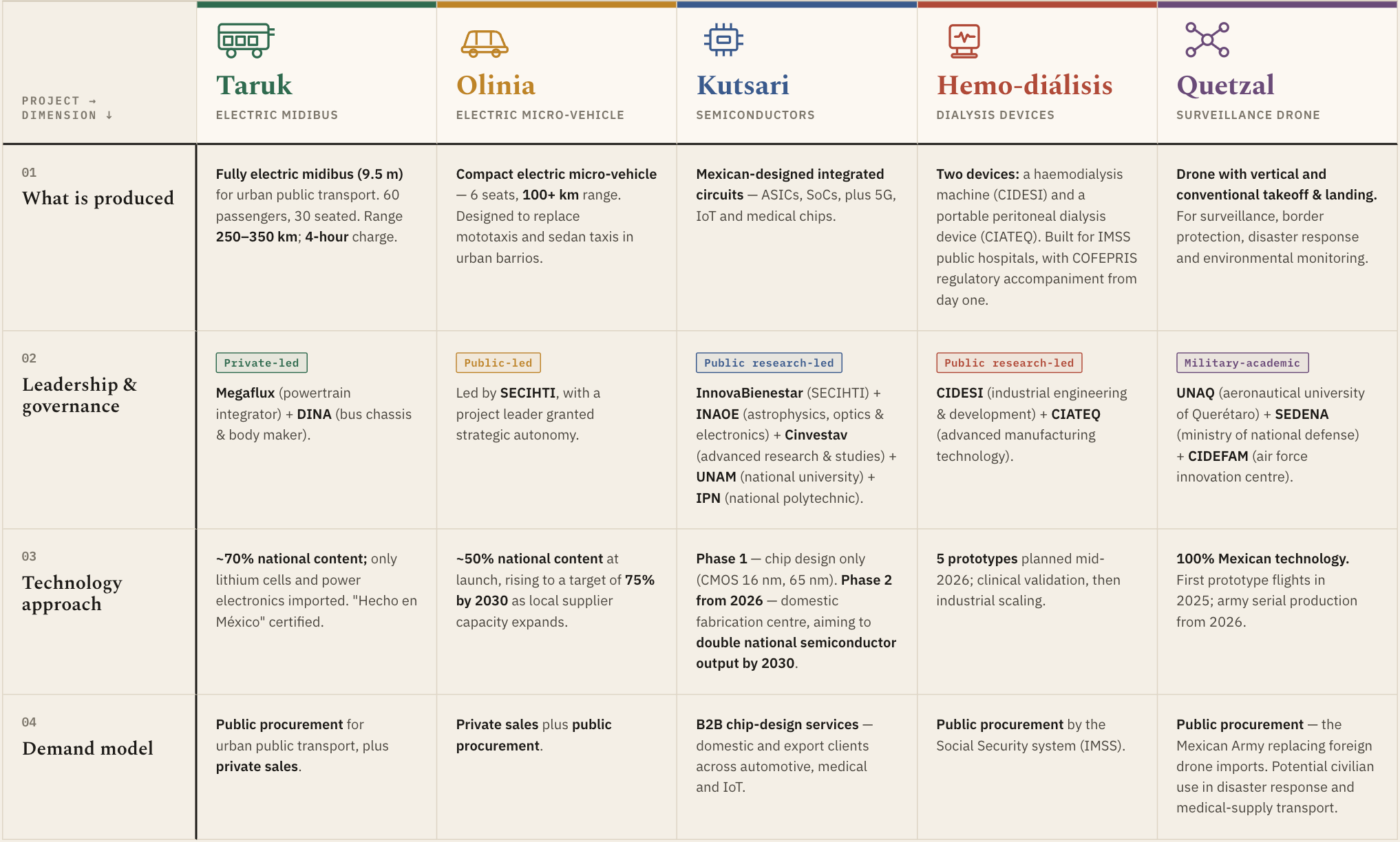
This diversity brings in an additional strength: as platforms with the freedom to experiment, projects like Olinia and Taruk can accelerate learning processes and help identify critical success factors that can then be integrated and replicated.
So far, even though Olinia is yet to be produced at scale, both projects have already brought movement into the electric mobility sector in Mexico. Thus, private Mexican electric vehicle producers like Zacua that are not part of the projects have released statements that embrace the efforts of Olinia to put Mexico on the map of electric mobility. Taruk is currently producing its first fleet to be operated in Chetumal, a medium-sized city close to Mexico’s southern border.
Open Questions
Yet despite these first milestones, some important questions remain open.
One, specifically concerning Olinia, is the definition of objectives and milestones beyond the prototype. A key lesson from the experience of the East Asian tigers is the importance of evolutionary discipline. Now that Olinia has successfully produced its first prototype, it is important for the government to have clear future milestones and ambitious market targets, first at home and then on global markets. Given the public interest generated by Olinia, it is also important to think about using that public scrutiny as a strategic lever to impose performance and demonstrate that the government is serious about the limits of state support for strategic projects.
Another is whether Olinia and Taruk can catalyse followers and support the development of a broader Mexican electric mobility ecosystem. Here it is useful to recall an important historical lesson from the East Asian miracle. Japan and South Korea are famous for the role of established domestic enterprises in their industrial transformations. Supported and disciplined by developmental states, these firms became essential agents of structural change. Thus, Mitsubishi started as a shipping firm in 1870 and evolved into a diversified business group spanning cars, banking, chemicals, and aerospace. Similarly, Samsung began as a trading company selling dried fish and noodles before diversifying into heavy industry, electronics, and semiconductors. An important question for Mexico will therefore be whether its own major conglomerates — e.g., Grupo Carso, Cemex, Grupo Bimbo — can be pushed into comparable roles.
Finally, it is worth remembering something important about the role of the state as a first mover: flagship projects are sometimes as important in their failure as in their success. Even failed flagship projects do generate capabilities, help reveal costs, and diffuse tacit knowledge, which lower the barriers to entry for followers.
La Primera Tortilla
There is an old tradition when making pancakes, crêpes, or, even more appropriately, tortillas, that the first one is always a test. It is made to gauge the heat of the pan and is expected to come out imperfect, but it is always necessary as it provides strategic information. Olinia may be seen as the first tortilla. What matters is not just whether this particular vehicle succeeds in the market. It is whether Mexico has learned enough from making it to know what to cook next.
Source: https://theicct.org/publication/latin-america-ebus-market-monitor-2024-may25/
Source: https://elements.visualcapitalist.com/where-chinese-evs-are-selling-the-most-worldwide/
This was an incredibly insightful read, thank you for this.
In this case I think your piece has demonstrated very clearly how industrial policy does generate political energy, as you state, but importantly it produces a spectrum of affects for the people themselves.
If the dominant national story is Mexico and Mexicans are excellent hands and location for other people’s blueprints that becomes the horizon they plan around. But here we see a new precedent being set, a national project with visibility (the good and the bad!) which demonstrates possibility. I think of Arjun Appaduri’s work here. He highlights how the “capacity to aspire” is unevenly distributed within and between societies. Some people, and indeed some nations, have a thicker more practiced map of where ambition could lead, because they’ve modeled it. Industrial policy that only optimises for what can be built for others eventually produces a population that has an internalised ceiling. But here we see ceiling being pushed, Mexicans are asking about what they want to build and I think it has the capacity to revise what generations to come believe is available to attempt.
And I really appreciate the tortilla analogy at the end, even in places like Saudi, there are many projects that have succeeded, despite the heavy focus on those which have or are not coming to life the way they were imagined.