

A bio-inspired technological revolution: The Economics Behind Oxford's Nature's Intelligence Studio
Bio-inspiration is not just good ecology, it is also good economics


By Amir Lebdioui and Angel Melguizo
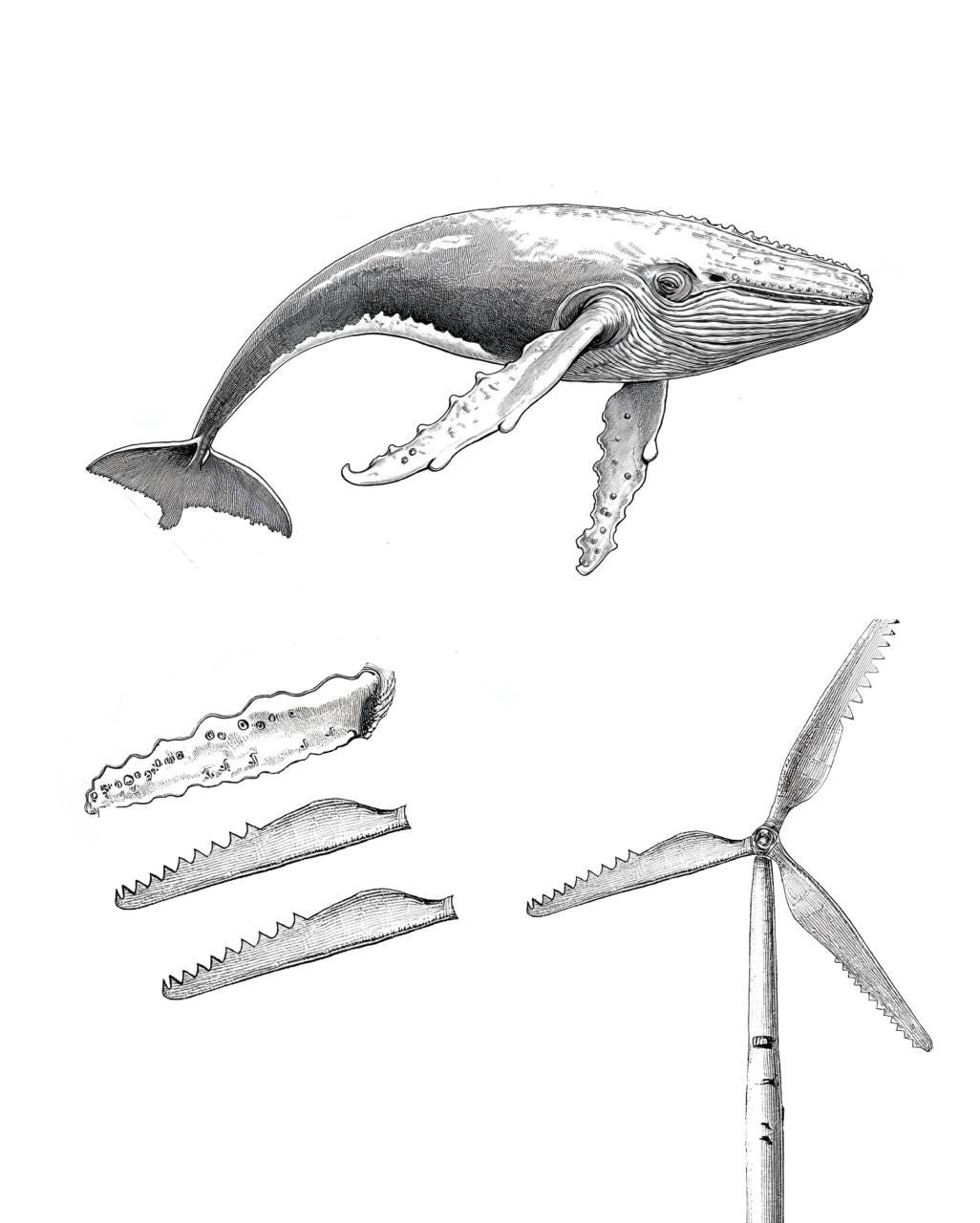
Whale-Inspired Wind Turbines
© TIDE Exhibition @ COP30
Following Carlota Perez’s framework identifying five technological revolutions that have occurred since the industrial revolution (steam, railways, steel/electricity, oil/automobiles, ICT), we argue that bio-inspired innovation is a candidate for the sixth technological revolution, one whose key factor inputs (biodiversity, evolutionary algorithms, biological materials) happen to be concentrated in the Global South rather than in the incumbent industrial core. Yet, a series of market failures is hindering the ascent of bio-inspired innovation.
When the TIDE Centre at the University of Oxford launched its Nature’s Intelligence Studio at COP30 in November 2025, it was framed as an initiative to unlock the innovation potential of biodiversity. But beneath the evocative imagery of hummingbirds and spider silk lies a rigorous economic case: one addressing issues of comparative advantage, information asymmetry, Schumpeterian disruption, and unequal exchange between where bio-inspired value is created and where the core inputs for innovations (biodiversity) are conserved and protected. Understanding those foundations helps explain why this Studio is a direct response to some of the bio-inspired innovation field’s most persistent puzzles.
Biodiversity as Comparative Advantage for Structural Transformation?
Classical trade theory since David Ricardo tells us that nations should specialise in what they are relatively well-endowed to produce. For most of economic history, the Global South’s endowments (minerals, soil, sun) have been treated as inputs into Northern-designed industrial processes. The result has been commodity dependency: exporting raw materials cheaply, importing finished goods expensively.
Biomimicry (or bio-inspired innovation, to be more accurate) reframes what counts as an endowment. The tropical forests of Latin America, the coral ecosystems of Southeast Asia, and the savannahs of sub-Saharan Africa are not merely carbon sinks or tourist destinations. They are the world’s densest concentrations of evolutionary problem-solving thanks to 3.8 billion years of R&D, encoded in species that have mastered efficiency, resilience, and circularity far beyond anything human engineers have achieved (Benyus, 1997). The mantis shrimp’s visual system is inspiring new camera sensors; the gecko’s foot is redesigning adhesives; the Namibian fog beetle is informing water harvesting in arid climates. Countries with high biodiversity (overwhelmingly in the Global South) hold a genuine comparative advantage in nature-inspired innovation (Lebdioui, 2022). The Studio’s research programme is designed to help those countries actually exploit that advantage, rather than watch it be extracted by research institutions in the North.
The Double Asymmetry of Information: Stiglitz in the Jungle
The market for bio-inspired innovation suffers from a peculiar double information failure that Joseph Stiglitz’s framework on asymmetric information helps illuminate (Stiglitz and Weiss, 1992), though the asymmetry here runs in two directions simultaneously.
On one side, industry does not know what it does not know and may not recognise a problem until an innovative solution is provided. Companies wrestling with materials efficiency, thermal regulation, or structural resilience rarely think to look at how termites manage airflow in their mounds, or how bone achieves extraordinary strength-to-weight ratios. The problem is not that the solution does not exist, but that the problem-holder has no idea the solution is sitting in a biology journal, or in the field notes of an entomologist in Manaus (Brazil).
On the other side, biologists and ecologists in biodiverse countries often sit on observations that would be commercially transformative, if only they knew which industry problems those observations could solve. The kingfisher’s beak optimises drag reduction; the researcher who spent fifteen years studying it may have no idea that this is precisely the aerodynamic challenge Japan’s Shinkansen engineers were struggling with when they redesigned the bullet train’s nose.
The Studio’s newly launched Energy Atlas of Nature’s Solutions, developed in partnership with Asteria (a formidable AI-powered biomimicry platform backed by over 4 million scientific articles), connecting industrial energy challenges to biological models, is, in economic terms, a market-making mechanism. It is trying to create a market that cannot clear on its own because neither side can see the other. This is a coordination failure of the highest order, and addressing it requires a much deeper institutional intervention, not just a nudge, which is what the studio aims to solve.
Supply and Demand matchmaking
Relatedly, there is both a supply of bio-inspired solutions and a demand for sustainable technology, but the market is failing to match them at anything approaching socially optimal scale. On the supply side, nature-inspired innovation is growing rapidly, estimated to contribute US$1.6 trillion to global GDP by 2030, according to the Fermanian Business and Economic Institute, yet remains deeply underdeveloped relative to the available biological knowledge stock, particularly in the Global South. Research institutions, universities, and individual scientists generate insights that never reach commercialisation because they lack the networks, capital, and industry connections to do so.
On the demand side, energy companies, manufacturers, and infrastructure developers face mounting pressure to decarbonise and dematerialise their operations, especially exacerbated by the energy consumption of artificial intelligence compute (Melguizo, Jung and Katz, 2026). Many are spending heavily on conventional R&D, unaware that evolution has already solved (often more elegantly) the efficiency and resilience problems they are trying to crack.
The Nature’s Intelligence Studio sits at the intersection of these unmet supply and demand curves. Its three pillars (knowledge production and advocacy, supply-side incubation, and demand-side mobilisation) are, in the language of industrial policy, an attempt to address a market failure that no individual actor has the incentive or ability to resolve alone.
Schumpeterian Disruption from Below
Joseph Schumpeter and last year’s Nobel laureates Aghion and Howitt argued that growth advances through waves of creative destruction, in which new technologies render old ones obsolete and reconfigure entire industries. The canonical examples of steam power, electrification, and, more recently, computing were generated in the industrial core of the world economy. The periphery was largely a recipient of those waves, not their source.
Nature-inspired innovation offers a different topology of disruption. The knowledge inputs are not concentrated in Northern laboratories; they are dispersed across the natural ecosystems of the Global South. A bio-inspired building material derived from nacre (mother-of-pearl) does not require a semiconductor fab. A mycelium-based packaging technology does not require a petrochemical complex. The capital requirements for early-stage bio-inspired R&D are lower, the requisite inputs are locally available, and the potential for leapfrogging established industrial paradigms is real (Lebdioui, 2025). In many ways, this is Schumpeterian innovation with an inverted geography. Countries that have historically been latecomers in technological waves may, for the first time, be positioned at the frontier, not because they have caught up with existing technologies, but because the next wave of innovation is rooted in assets they already hold. The Studio’s ideathon, in partnership with the Development Bank of Latin America and the Caribbean (CAF), convened over 380 proposals from researchers, startups, and investors from Latin America and the Caribbean and is explicitly designed to nurture this dynamic rather than allow the knowledge to migrate North before value is captured.
The Value Distribution and the Principal-agent Problem: Who Captures the Gains and who preserves the library of bio-intelligence?
The final economic logic is the most straightforward but goes deeper than a simple redistribution question. It is, at its core, a principal-agent problem: communities that invest in conserving biodiversity are not those that are benefiting from the immense value generated by bio-inspired innovations. And the principals involved in bio-inspired innovation rely on the conversation of a library of bio-intelligence in the global south. This misalignment is not merely unjust. It is economically irrational: it destroys the very incentive structure needed to preserve the knowledge bank on which future innovation depends. Unlike a burnt library or bank that goes bust, there is no backup copy. The mantis shrimp’s visual system, the gecko’s adhesive foot, and the humpback whale’s tubercled fins all represent millions of years of evolutionary problem-solving. Once gone, that knowledge is irretrievable. The agent who might have preserved it had no economic reason to do so, because the principal who would have benefited never paid for the service.
The history of biodiversity-based industries offers a cautionary tale. From the rubber boom of the nineteenth century to the bioprospecting controversies of the 1990s (and the famous case of InBIO in Costa Rica), the pattern has been consistent: biological knowledge discovered in or extracted from Southern ecosystems generates value that accrues overwhelmingly in the North. The legal architecture of intellectual property (designed for industrial-age innovations) has consistently failed to protect the rights of source communities and biodiverse countries, and it remains a blind spot of the Nagoya Protocol, which retrains the movement of genetic material, but not inspiration from biological organisms.
Changing the geography of innovation without changing the architecture of value capture would be an expensive way to reproduce existing inequalities while simultaneously accelerating the destruction of the resource base that makes the innovation possible.
The Studio’s work to develop model legal frameworks for bio-inspired intellectual property rights, nature’s rights, and benefit-sharing mechanisms is therefore not peripheral to its economic mission, but it is perhaps the most structurally important part of it. Additionally, this would also address another of the barriers we witnessed on our field trips, the lack of trust among innovators when collaborating with large companies on industrial challenges.
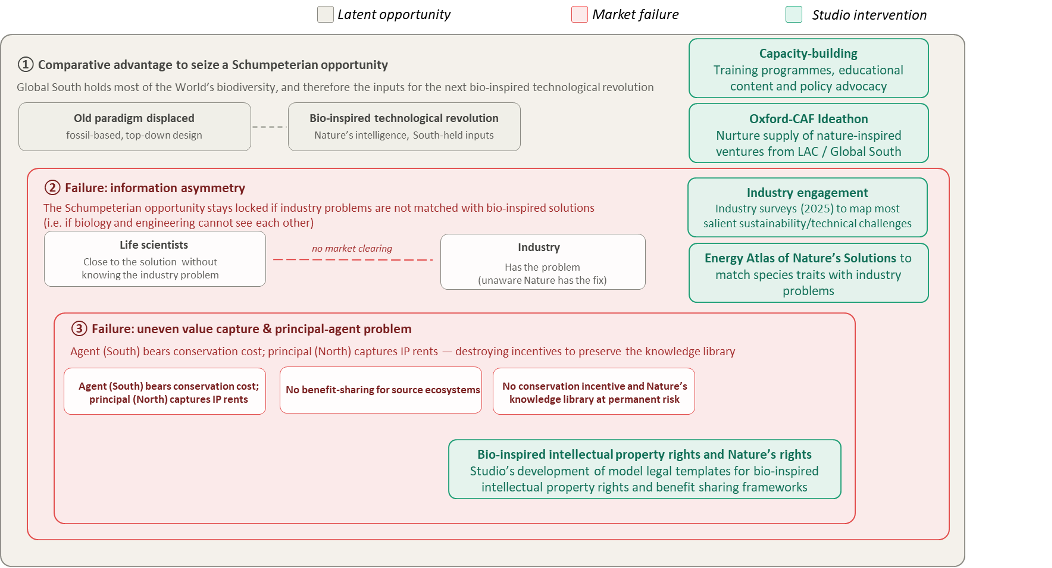
In sum, as economists looking at biomimicry, our instinct is to ask: where is the market failure, what are the incentives, and what is the most targeted intervention? Here, the answers are unusually clear. The world’s most biodiverse nations hold assets whose innovation value is systematically underpriced, imperfectly observed, and poorly matched to the industries that need them. Correcting that requires what the Studio is building: infrastructure for knowledge, institutions for value capture, and architecture for matching. Nature has had 3.8 billion years to get good at solving hard problems. The economic case for finally paying attention is, by now, overwhelming.
The Nature’s Intelligence Studio is an initiative of the TIDE Centre (Technology and Industrialisation for Development) at the University of Oxford. Contact: tide@qeh.ox.ac.uk
 | A guest post by
|
 | A guest post by
|